
One of the main side effects from acne is acne scarring, once spots disappear they can leave behind scars. Not everyone that has acne will also suffer from acne scarring however statistically one out of five people with acne will also develop acne scars. Read on to find out how to get rid of acne scarring with treatment at Revitalise Skincare Clinic.
Why does acne cause scars?
Scarring is a natural response from the body when you experience injury or inflammation. Acne scars are the result of inflammation from acne spots. You are more likely to develop scarring if you suffer from deep, cystic acne.
Acne scarring forms when the acne pores swell and a breakdown occurs in the wall of the pore. For small acne spots the scars tend to be shallow and heal quickly, whereas deep cystic spots can take months or even years to heal. The skins response to scarring is to repair it by forming new collagen fibres. Acne scars can develop when there is a loss of tissue, resulting in an indentation in the surface of the skin. A scar can also develop as a raised surface on the skin, when the skin creates too much collagen.
Whilst acne scars can fade overtime, they can be stubborn and are difficult to treat at home. Visiting a Registered Medical Practitioner, like Arvin at Revitalise Skincare Clinic, will give you an insight into treatment options that will relieve scarring.
What are the different types of acne scars?
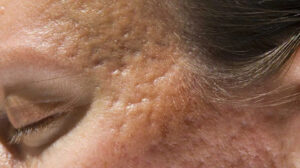
Pitted acne scarring typically forms as an after effect of cystic acne. It occurs because cysts form on the deeper layers of the skin, when they heal a gap is left behind between the skins layers. The upper layers of the skin then sink back to fill in the gap, resulting in a pitted appearance.
- Boxcar – boxcar is a type of pitted acne scarring, they are wide in size with deep indents and sharp edges. These scars are typically found on the lower cheeks and jawline.
- Icepick – this is the most common type of pitted acne scarring. An ice pick scar is typically wide at the top and narrows to a point as it goes deeper into the skin. They are typically found on the forehead and the cheeks.
- Rolling – rolling scars are pitted scars with sloping edges that make the skin look uneven. They typically appear on the lower cheeks and jaw where the skin is thicker.
- Hypertrophic/keloid – these types of scars appear as raised lesions of scar tissue. They form when collagen in the area of the acne overgrows whilst trying to repair the scar. They tend to appear on the body more so than the face.
- Post-inflammatory hyperpigmentation – this presents as a flat mark on the skin which is typically skin colour or slightly darker. These marks tend to disappear over time but can take months without treatment.
You should not pick, squeeze or pop breakouts as this increases inflammation in the skin. The more inflamed your skin is the more likely it is that acne scars will form.
What treatments do you offer for acne scarring?
An individualised approach to treatment is important as acne and acne scarring appears differently on different skin types. Prior to all treatment we offer a personalised consultation with our Medical Practitioner, Arvin, where a full assessment of the skin will take place. She will help you find the right treatment to help reduce the appearance of your acne scars. At Revitalise Skincare Clinic we offer a wide range of treatments for acne scarring, check out our treatment guide below.
Vivace – RF Microneedling
Vivace is the newest generation of RF microneedling, it uses a combination of radio frequency and microneedling to rebuild collagen in the skin. By adding the heat of radio frequency, Vivace is able to deliver more intense skin rejuvenation benefits than traditional microneedling devices. When the pins on the device enter the skin, they transmit radio frequency energy through multiple levels of the skin. Through this process, the skin receives controlled injury plus the added effect of heat. This dual effect creates dramatic collagen production which rebuilds the deeper layers of the skin.
Scar Subcision
Scar subcision is a technique we use to treat acne scarring, particularly pitted acne scarring. It works by inserting a special needle, known as a blunt-tipped cannula, under the skin to break down fibrous scar tissue. By removing fibrous scar tissue, it encourages the production of new collagen to fill in the scars which results in smoother looking skin.
Polynucleotides
Polynucleotides is a revolutionary injectable treatment. Treatment is delivered via microinjections into the skin which encourages fibroblasts to produce new collagen fibres and elastin. The enhanced collagen production in the skin helps to smooth out depressed acne scars. Having regular polynucleotides treatment will allow the skin to rebuild itself from within, leaving you with an even and smooth complexion.
Fractional Skin Needling
Fractional Skin Needling treatment works by using multiple needles that vertically pierce the skin, this creates thousands of tiny holes that cause the skin to release serum growth factors. It stimulates the breakdown of old fibrous collagen and causes new collagen and elastin development. Results are comparable to laser resurfacing devices but at a fraction of the cost with much less downtime. Depending on the severity of your acne scarring, multiple treatments may be needed for desired results.
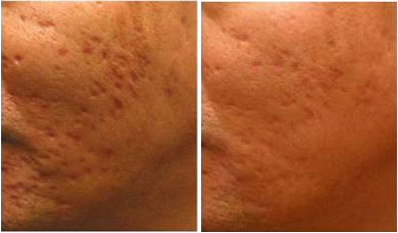
Above shows how effective Fractional Skin Needling works on deep pitted acne scarring, you can see the skin looks much smoother and scarring is reduced.
Hydrafacial
Hydrafacial treatment offers instant, noticeable results with no downtime or irritation. The 6 step facial removes dead skin cells, extracts impurities and bathes the skin with cleansing, moisturising and hydrating serums. Deep skin exfoliation effectively removes dead skin cells and clears clogged pores which in turn helps acne scars fade over time leaving you with fresh, even toned skin.
Dermalux LED Phototherapy
Dermalux LED Phototherapy is an award winning treatment that harnesses the power of natural light to reveal naturally radiant and rejuvenated skin. The treatment delivers skin specific treatments using a combination of blue, red and near infrared wave lengths. Dermalux blue light provides anti bacterial action that treats acne without irritation and improves skins clarity. Dermalux near infrared light has advanced skin rejuvenation benefits that calms redness and irritation.
Chemical peels
A chemical peel is a treatment we use to improve skin texture and tone. An acid is applied to the skin to lower the PH, which loosens the connections between dead skin cells. This process causes superficial layers of the skin to peel off which reveals a smoother and more radiant complexion.
At Revitalise Skincare Clinic we use Obagi Blue Peel Radiance, it is effect in improving the appearance of blemishes and rough, uneven skin. Blue Peel Radiance is a salicylic acid based peel, that we can use on a wide range of skin types. Salicylic acid is used to treat acne by reducing inflammation and unplugging blocked pores. It is a quick and easy procedure that makes the skin look brighter, smoother and tighter after just 1 treatment.
Dermal Fillers
If you are looking for a quick fix for your acne scarring, then dermal fillers is an option. Filler is injected into areas where the skin is pitted to rebuild and fill. Results can be seen immediately however treatment t is likely to be needed every 6-12 months to maintain results.
If you are struggling with acne scarring and would like to discuss the different treatment options we offer at Revitalise Skincare Clinic with our Advanced Nurse Practitioner, then contact us today. We are here to help you achieve your skin goals.
Contact Number – 01225 760 556
Email Address – [email protected]
Why not check out some of our other blog posts?
Lesion removal in Bath, Somerset and Wiltshire